






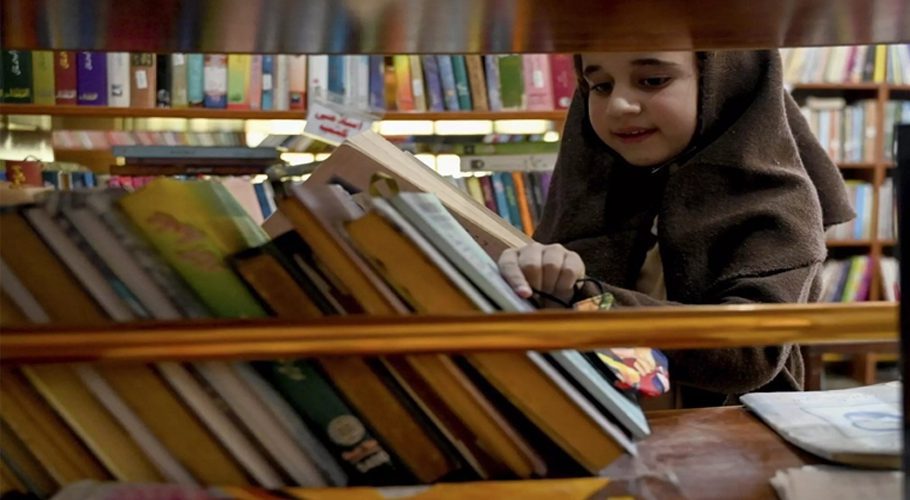
Darra Adamkhel, the town known as Pakistan’s Wild West due to its black-market bazaars stocked with forged American rifles, replica revolvers and rip-off AK-47s, has another side hidden from the world, its reading community.
The town of Darra Adamkhel, which is located in the extremely conservative tribal region, has a history of insurgency and drug trafficking, earning it a reputation as a “wild west” crossing point between Pakistan and Afghanistan.

It has a lengthy history of producing rip-off AK-47s, replica revolvers, and forged American rifles.
However, a nearby town library is thriving thanks to its selection of books, which includes Mrs. Dalloway by Virginia Woolf, the teenage vampire romance novel Twilight, ‘Life, Speeches and Letters’ by Abraham Lincoln.
“It’s my hobby, my favorite hobby, so sometimes I sneak off,” the 28-year-old arms dealer Muhammad Jahanzeb was quoted as saying in AFP report.
“I’ve always wished that we would have a library here, and my wish has come true.”
“Initially we were discouraged. People asked, ‘What is the use of books in a place like Darra Adamkhel? Who would ever read here?'” recalled 36-year-old founder Raj Muhammad.
“We now have more than 500 members.”

Due to poverty, patriarchal beliefs, interclan violence, and a lack of educational opportunities, Pakistan’s tribal areas, which had semi-autonomous status until 2018 when they amalgamated with the neighboring province of Khyber Pakhtunkhwa, have some of the lowest literacy rates nationwide.

But attitudes are slowing changing, believes soft-spoken 33-year-old volunteer librarian Shafiullah Afridi: “Especially among the younger generation who are now interested in education instead of weapons.”
“When people see young people in their neighborhood becoming doctors and engineers, others also start sending their children to school,” said Afridi, who has curated a ledger of 4,000 titles in three languages — English, Urdu and Pashto.
Libraries are rare in Pakistan’s rural areas, and the few that exist in urban centers are often poorly stocked and infrequently used.
In Darra Adamkhel, it began as a solitary reading room in 2018 stocked with Muhammad’s personal collection, above one of the hundreds of gun shops in the central bazaar.
“You could say we planted the library on a pile of weapons,” said Muhammad — a prominent local academic, poet and teacher hailing from a long line of gunsmiths.
Muhammad paid 2,500 rupees ($11) for the monthly rent, but bibliophiles struggled to concentrate amidst the whirring of lathes and hammering of metal as bootleg armourers plied their trade downstairs.
The project quickly surpassed the confines of a single room, so it was moved to a purpose-built, one-story building on donated land a year later.
A library card costs 150 rupees ($0.66) for the general public per year, 100 rupees ($0.44) for students, and children frequently enter and exit the building even when classes are not in session.
One in ten members are female, an unusually high proportion for tribal communities, but as they reach adolescence and are alone at home, male family members start collecting books on their behalf.
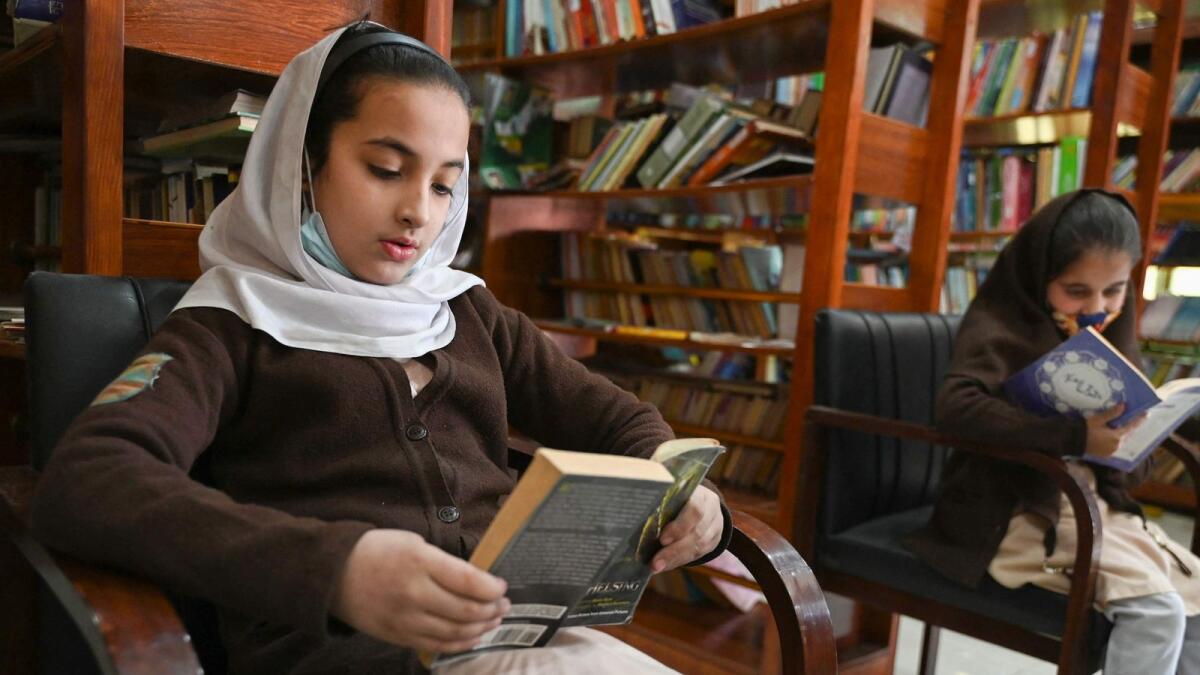
However, Manahil Jahangir, 9, and Hareem Saeed, 5, join the men who are much taller than children as they read books during their mid-morning break.
“My mother’s dream is for me to become a doctor,” Saeed says shyly. “If I study here, I can make her dream come true.”