










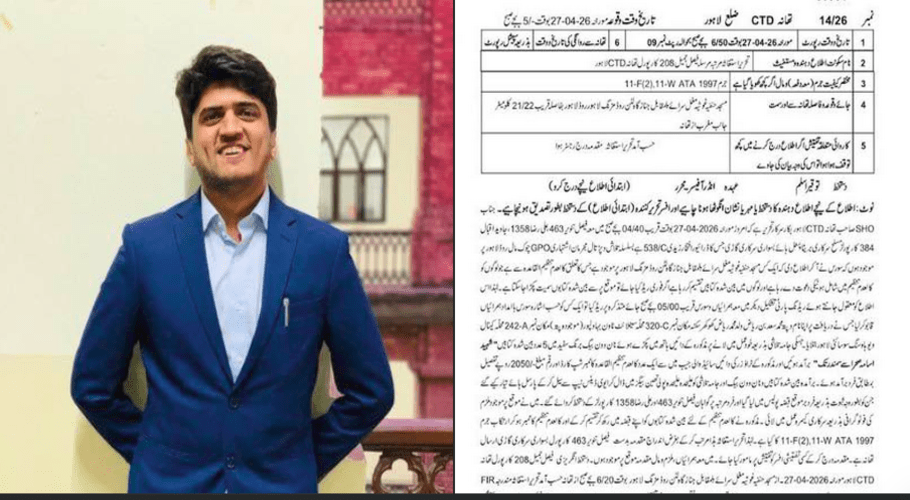
LAHORE: The case against Saad Riaz, a researcher and contributor to the YouTube channel @EonHoldings, has raised conflicting accounts that challenge the official version of events put forward by Punjab’s Counter Terrorism Department.
An FIR registered in Lahore accuses Riaz of preaching Al-Qaeda’s ideology at Masjid Hanfia Ghousia and claims an Al-Qaeda membership card was recovered from him. The FIR further alleges he was arrested at the mosque while distributing banned literature to recruit members.
لاہور میں مشہور یوٹیوب چینل @EonHoldings میں کام کرنے والے سعد ریاض @hafizsaadriaz کو اغوا کرنے کے بعد ان پر ایف آئی آر درج کی گئی ہے کہ وہ مسجد حنفیہ غوثیہ میں القاعدہ کی دعوت دے رہے تھے اور انکے پاس القاعدہ کا ممبر شپ بھی تھا، جو کہ برآمد کر لیا گیا ہے۔۔۔ ماشاءاللہ بریلوی مسلک… https://t.co/wc4r8hxTk1
— Majid Nizami (@majidsnizami) May 1, 2026
But multiple discrepancies have emerged.
1. The location of arrest is disputed.
According to Ibrahim Jaffri of Raftar digital media, Riaz was not picked up from the mosque. Jaffri claims Riaz, also known as Hafiz Saad Riaz, was taken from his residence late at night by CTD personnel several days before the FIR was filed. He asserts that CCTV footage from the residence contradicts the FIR’s account of a mosque arrest. The footage has not been independently verified by this reporter.
2. The alleged venue conflicts with the accusation.
Masjid Hanfia Ghousia is affiliated with the Barelvi school of thought, a Sunni sub-sect that has historically opposed Al-Qaeda and Takfiri militant groups. Analysts note that openly preaching for Al-Qaeda in a Barelvi mosque would be ideologically incongruous and likely to draw immediate opposition from congregants.
3. The accused’s public record contrasts with the FIR’s claims.
People familiar with Riaz’s work say his publicly expressed views have characterized Al-Qaeda as a terrorist organization. His associates describe him as an academic who has written on conflicts in Kashmir, Gaza, Afghanistan, and Syria, focusing on what they call “narrative warfare” against dominant powers.
Riaz’s family and the Eon Podcast team confirmed they chose to go public now that the matter is before the courts. In a statement, they said they “believe in the rule of law taking its course and justice to prevail.” They declined to comment further on the specifics of the allegations, citing the ongoing legal process.
The CTD has not responded to requests for comment on the alleged procedural irregularities, including claims of illegal custody prior to the FIR and the dispute over the arrest location.
Legal experts say the contradictions between the FIR narrative and the claims made by Riaz’s associates are likely to be central when the case proceeds. “When the place and manner of arrest are contested, it raises evidentiary questions the prosecution will have to answer,” said a Lahore-based criminal lawyer who asked not to be named due to the sensitivity of terrorism cases.
For now, the case highlights a familiar pattern in Pakistan’s counterterrorism landscape: high-stakes allegations, followed by disputes over due process.
Riaz remains in judicial custody as proceedings continue.