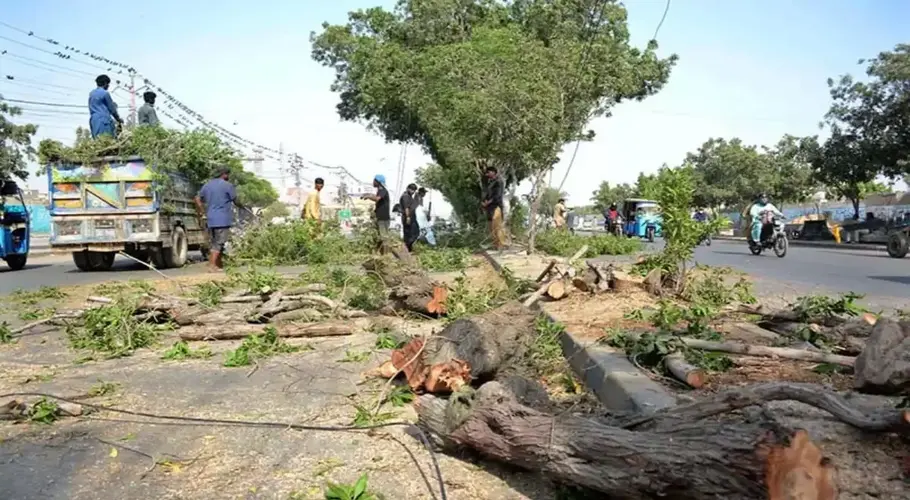
KARACHI: Pakistan’s financial capital is suffocating. Once known for its sprawling gardens and temperate breezes, Karachi has transformed into a relentless “concrete jungle,” with experts warning that its green cover has plummeted to a negligible fraction of its urban footprint.
Recent data paints a harrowing picture: the city now averages a mere 4.17 square metres of green space per capita—falling drastically short of the World Health Organization’s recommended 9 square metres.
The crisis is not merely an aesthetic grievance but a structural failure born of decades of unchecked urbanization and regulatory apathy. Research highlights that between 2008 and 2019 alone, the city lost over 20 percent of its tree cover, a decline fueled by the systematic replacement of parks and open playgrounds with high-density commercial and residential projects. This loss is compounded by a total breakdown in enforcement; building codes are frequently bypassed, and natural drainage paths are choked by haphazard construction, effectively sealing the city in a thermal trap.
The consequences of this “greed-over-green” approach are now manifesting in lethal climate impacts. Without vegetation to mitigate the “urban heat island” effect—where concrete surfaces absorb and radiate heat—Karachi’s residents are increasingly exposed to punishing heatwaves and severe flooding. The situation is so dire that in several union councils, green space is virtually non-existent, recorded at less than 0.1 square metres per person.
While government officials frequently promote tree plantation drives, experts remain deeply skeptical, labeling these efforts as disjointed and insufficient. Critics argue that without a fundamental shift in policy—such as mandating land allocation for parks in new developments and enforcing strict protections for remaining green zones—the city’s environment will continue its downward spiral.
As the metropolis continues to expand, the message from the scientific community is clear: Karachi is running out of time to reclaim its breath.