











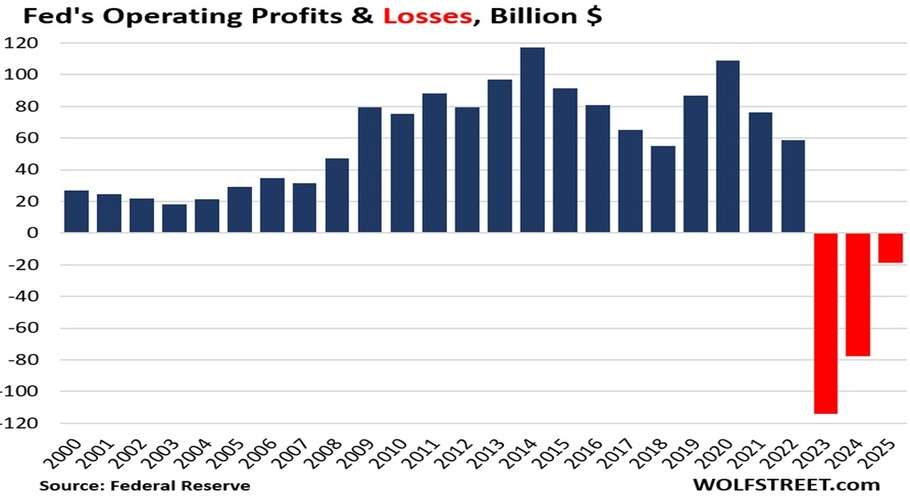
The Federal Reserve’s 2025 financial results reveal an institution in the third year of operating losses—$18.7 billion—yet showing signs of stabilization. This represents a significant improvement from the $114 billion loss in 2023 and $77.6 billion in 2024, but it masks deeper structural tensions that will shape America’s economic trajectory through 2026 and and beyond.
Monteary experts believe America is navigating the legacy of 15 years of extraordinary monetary policy (2008-2024) meeting demographic shifts and fiscal stress. The Fed’s financial stress reflects structural monetary policy challenges spanning multiple administrations, not a partisan phenomenon attributable to one president. The 2025 results show stabilization (losses narrowing) rather than deterioration—but this recovery remains fragile and heavily constrained by the balance sheet overhang.
The Narrowing Losses Paradox
While the Fed’s operating losses declined sharply in 2025, this “improvement” stems primarily from lower interest expenses ($167 billion vs. $227 billion in 2024) rather than enhanced profitability. The central bank remains trapped in a fiscal vise: it cannot resume remittances to the Treasury until cumulative losses are erased. With deferred assets ballooning to $243.5 billion, the Fed has essentially created an IOU to itself that grows larger each year it fails to generate operating surpluses.
Unlike private banks, the Fed faces no solvency risk—it creates money.It holds securities to maturity. However, the suspension of Treasury remittances (historically averaging $75 billion annually) removes a crucial revenue stream from federal coffers precisely when Washington faces unprecedented borrowing needs.
The Unrealized Loss Iceberg: $844 Billion Beneath the Surface
More alarming than operating losses is the $844 billion in unrealized losses on the Fed’s Treasury and mortgage-backed securities portfolio—representing 18 times the central bank’s reported capital. These paper losses, while not marked-to-market, reflect the Fed’s exposure to interest rate risk from its $6.5 trillion balance sheet.
The Fed’s “hold to maturity” accounting treatment means these losses remain theoretical until forced sales or maturity. Yet this positions the central bank as a massive, leveraged bond fund vulnerable to:
– Interest rate volatility: If rates rise further, unrealized losses deepen
– Fiscal pressure: Congress may eventually demand asset sales to fund government operations
– Market dysfunction: Forced liquidation could crystallize losses and disrupt Treasury markets
Monetary Policy at a Crossroads
The Fed’s June 2025 Monetary Policy Report reveals an institution recalibrating its framework after the inflation surge of 2021-2023.. Key directional shifts include:
1. Abandoning “Flexible Average Inflation Targeting” (FAIT)
The 2020 framework’s commitment to let inflation run “moderately above 2 percent for some time” after undershooting has been effectively abandoned.. Chair Powell acknowledged at Jackson Hole 2025 that there was “nothing intentional or moderate” about the post-pandemic inflation spike. The Fed has returned to traditional 2% inflation targeting without the “average” qualifier—removing asymmetry that previously favored employment “shortfalls” over inflation deviations.
2. The “Balanced Approach” Restoration
The 2025 framework removes language suggesting the Fed would tolerate employment “shortfalls” (weakness) more aggressively than inflation overshoots. Instead, it emphasizes symmetry: When employment and inflation objectives conflict, the Fed will follow a “balanced approach” considering the magnitude of departures and projected time horizons for returning to mandate-consistent levels.
3. Forward Guidance Uncertainty
The Fed explicitly declined to provide new guidance on deploying unconventional tools (QE, forward guidance) or lessons learned from pandemic-era interventions. This institutional humility reflects uncertainty about whether the 2020s “new normal” of low rates, low inflation, and flat Phillips curves has truly ended—or merely paused.
Where the Economy Is Heading: Three Scenarios
Scenario A: “Soft Landing” Achieved (Baseline 40% probability)
If inflation continues moderating toward 2% without recession, the Fed maintains rates at 4.25-4.50% through late 2026, gradually normalizing as Treasury remittances resume. The deferred asset slowly amortizes. Real GDP growth stabilizes at 2%, unemployment remains near 4.5%, and the Fed rebuilds capital buffers.
Scenario B: “Stagflation Lite” (Probability 35%)
Energy price shocks and tariff uncertainty keep inflation sticky around 3% while growth slows to 1%. The Fed faces an impossible trilemma: cutting rates risks inflation acceleration; holding steady risks recession; hiking risks financial instability. Political pressure mounts for rate cuts ahead of 2026 midterms despite inflation remaining above target.
Scenario C: “Fiscal Dominance” (Probability 25%)
Exploding federal deficits—projected to exceed $2 trillion annually—force Treasury to rely increasingly on Fed monetization. The Fed faces pressure to cap yields or曲线的特定部分, effectively financial repression. Independence erodes as Congress demands monetary financing of spending. Dollar weakness and imported inflation follow.
The Structural Headwinds
Demographic Drag: The labor force participation constraints and aging population suggest “maximum employment” may be lower than pre-pandemic assumptions, complicating the Fed’s dual mandate.
Fiscal-Monetary Collision: With interest expenses consuming nearly 15% of federal revenue, the traditional separation between fiscal and monetary policy blurs. Treasury issuance increasingly crowds out private investment.
Global De-Dollarization: Central bank reserve diversification away from Treasuries reduces demand for the very assets the Fed holds trillions of, potentially forcing higher term premiums or failed auctions.
The New Abnormal
America is heading toward a period of constrained monetary sovereignty. The Fed retains its operational independence but faces diminished effectiveness—its balance sheet too large, its losses too deep, its policy rate stuck in “restrictive” territory (4.25-4.50%) while fiscal needs scream for accommodation.
The most likely path forward involves:
1. Prolonged Treasury remittance suspension (through 2027 at minimum)
2. Eventual balance sheet normalization via natural runoff rather than active sales
3. Acceptance of 2.5-3% as the “new” inflation floor—the 2% target becomes a ceiling rather than symmetric objective
4. Greater coordination with Treasury on debt Management Office strategies, blurring operational independence
The era of the Fed as profit-center for Treasury (remitting $75B+ annually) has ended. The new normal features a weakened, loss-absorbing central bank navigating between inflation volatility, fiscal dominance pressures, and structural growth constraints—hardly the “abundant caution” Alan Greenspan once counseled, but rather a constrained caution born of depleted ammunition after 15 years of extraordinary measures.