











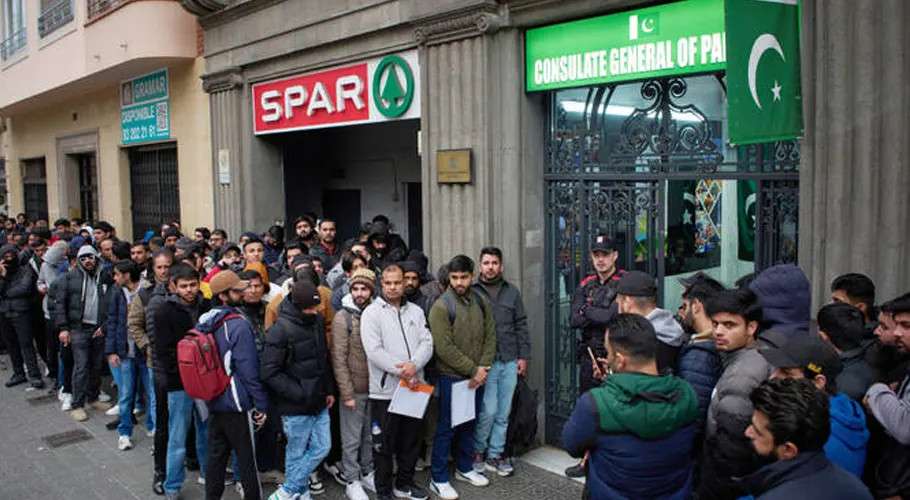
MADRID: Spain has announced a major overhaul of its immigration policy, introducing a wide-ranging regularisation programme that is expected to grant legal residency and work permits to hundreds of thousands of undocumented migrants.
The move, described by the government as both “necessary and fair,” aims to integrate migrants already living in the country into the formal economy while addressing persistent labour shortages across key sectors.
Under the new policy, migrants who entered Spain before a specified cutoff date — reportedly set around early 2026 — will be eligible to apply for legal status. Applicants will be required to demonstrate continuous residence in the country for a minimum period, provide proof of employment or economic activity, and maintain a clean criminal record.
Successful applicants will be granted temporary residency along with work authorisation, typically valid for one year, with the possibility of renewal subject to compliance with legal requirements.
Officials estimate that the programme could benefit between 500,000 and 800,000 migrants, making it one of the largest regularisation efforts undertaken by a European country in recent years.
Prime Minister Pedro Sánchez said the policy reflects Spain’s commitment to fairness and economic pragmatism, noting that many undocumented migrants are already contributing to the country’s workforce.
“This is about recognising reality and acting responsibly,” he said, adding that the reform would help bring more workers into the legal system, improve tax collection, and strengthen labour protections.
Government officials also highlighted that sectors such as agriculture, construction, and tourism — which have faced chronic labour shortages — are expected to benefit significantly from the influx of legally recognised workers.
However, the announcement has sparked criticism from opposition parties, who warned that the policy could strain public services and administrative infrastructure, while also raising concerns over its long-term social and economic impact.
Spain’s approach contrasts with stricter immigration measures being adopted elsewhere in Europe, positioning the country as pursuing a more inclusive strategy focused on regularising existing migrants rather than enforcing mass deportations.