










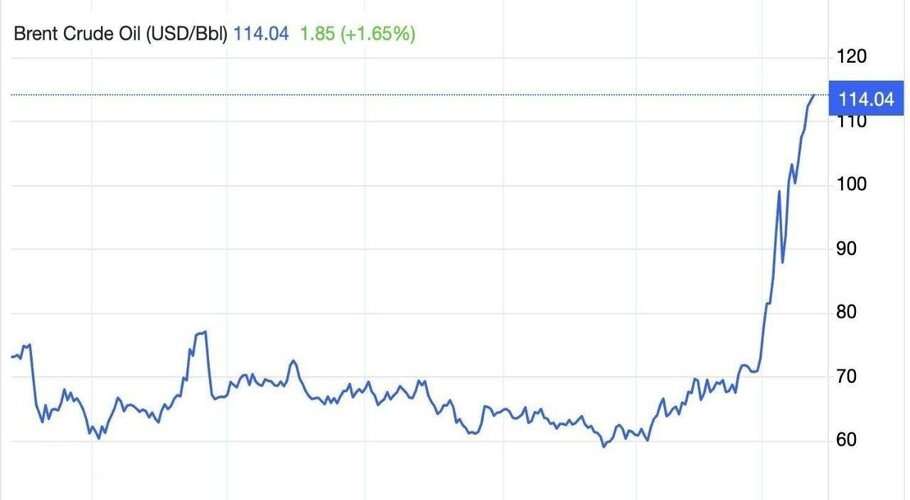
Brent crude rose to nearly $114 a barrel on Sunday before trimming gains, as oil markets reacted to fresh threats traded between the United States and Iran amid a widening Middle East conflict.
Western media reports suggest prices climbed after U.S. President Donald Trump on Saturday warned the United States would target Iran’s power plants — starting with what he called its “biggest one” — if Tehran did not reopen the Strait of Hormuz within 48 hours. Iran on Sunday retaliated by threatening strikes on infrastructure belonging to the United States and Israel across the Middle East.
The Strait of Hormuz, a narrow waterway off Iran’s coast through which about 20% of the world’s oil and liquefied natural gas flows, has been at the centre of market concern after Tehran attacked vessels it said were linked to the U.S. and Israel while allowing others to pass. Traders say the near closure of the strait is the main catalyst for the spike in oil prices.
“The outcome and Trump’s next steps, particularly in the event of escalation, would have significant implications for markets through the remainder of the week and into month and quarter end,” Chris Weston, head of research at Pepperstone, wrote in a note on Monday.
Brent crude futures were up 0.5% at $112.78 a barrel at 12:10 a.m. ET on Monday, while U.S. West Texas Intermediate (WTI) rose 0.9% to $99.07 a barrel. Both grades had swung between gains and losses earlier in the session.
Oil has surged since the start of the conflict: a barrel traded around $70 before U.S. and Israeli strikes on Iran began on Feb. 28. The higher oil prices have fed through to U.S. pump prices, with gasoline close to averaging $4 a gallon, adding political pressure on Trump, who campaigned in 2024 on promises to lower energy costs for American consumers.