










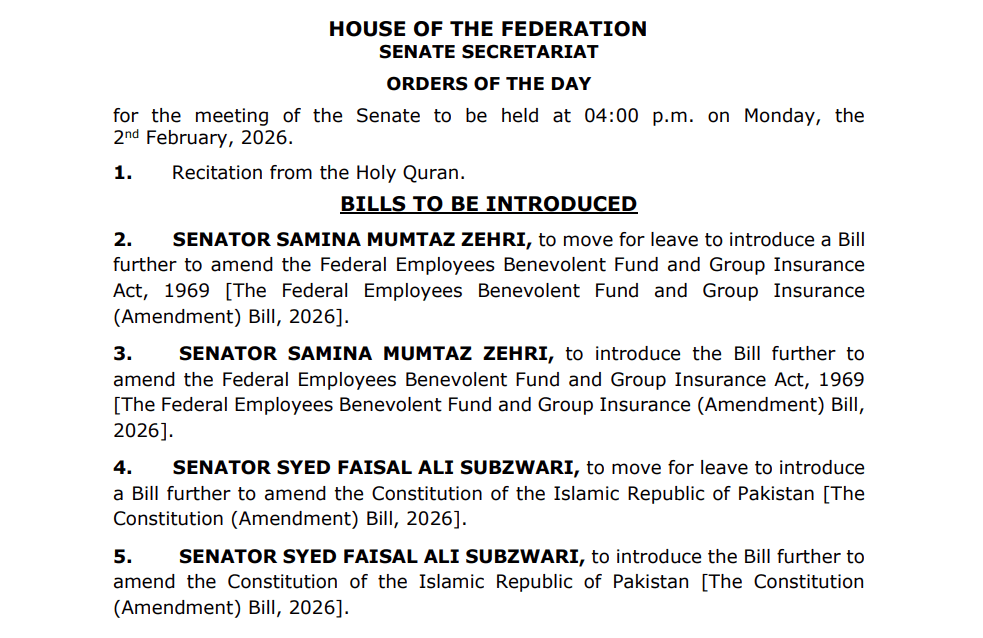
A landmark constitutional amendment bill, proposed by Muttahida Qaumi Movement-Pakistan (MQM-P) Senator Faisal Subzwari, has officially been included in the Senate’s agenda for today’s session on 2nd February, 2026 on Monday.
What the Proposed Changes Mean for Karachi?
The bill seeks to fundamentally reshape the local government landscape in Pakistan by shifting administrative control from the provincial level to a more standardized federal framework.
The proposed amendment is seen as a fulfillment of MQM-P’s long-standing demand for empowered local bodies, a condition the party had emphasized during its entry into the federal coalition.
The amendment proposes several radical changes to the current local government structure to ensure administrative and financial autonomy.
- The federation, rather than individual provinces, will be responsible for establishing the local government system across the country.
- Any city with a population exceeding one million will be mandated to have a metropolitan city government.
- In a major shift toward direct democracy, the mayor or chairman of the local government will be elected through a direct vote from the citizens.
- The term for local governments will be fixed at five years, starting from the date of the first meeting.
- To prevent lengthy delays and “administrator-led” periods, elections must be held one month before the current term expires.
The “28th Amendment” Context
Following the passage of the 26th and 27th Amendments earlier this year, which focused on the judiciary and military command structures, MQM-P is pushing for this to be recognized as the 28th Constitutional Amendment.
“Empowering local governments is not just a Karachi issue; it is a national necessity for grassroots development,” Senator Subzwari stated previously.
Expected Impact
If passed, this bill would significantly limit the powers of provincial governments to delay local polls or withhold funds.
It aims to institutionalize the “third tier” of government, ensuring that municipal issues like water, sanitation, and transport are managed by representatives who are directly accountable to the public.