











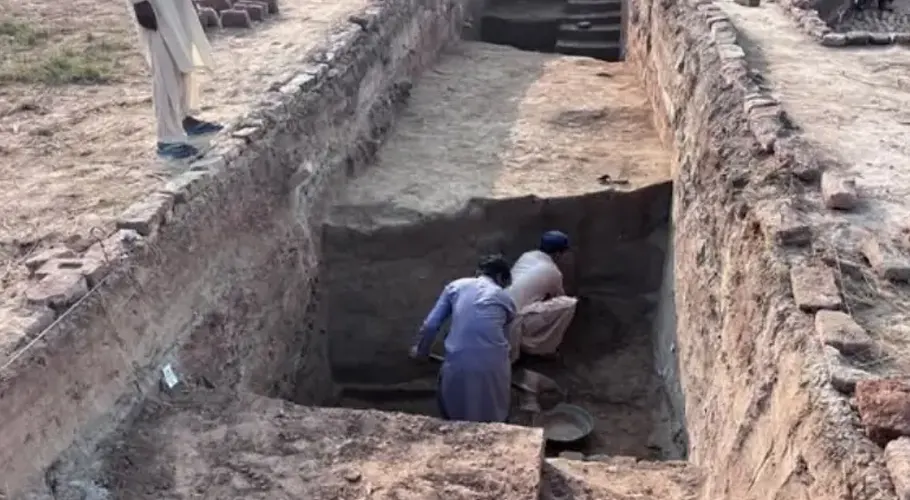
Archaeologists have uncovered a defensive wall, built to protect the city, during recent excavations at at Mohenjo-daro, one of Sindh’s most ancient historical sites.
According to the Sindh Department of Antiquities and Archaeology, this protective wall, constructed of mud bricks around the central city, has come to light after a long period and is being described by experts as a crucial component of Mohenjo-daro’s urban system.
The department said that excavations at Mohenjo-daro are currently underway as part of a joint Pakistan–United States archaeological mission. The project is being supervised by American archaeologist Professor Jonathan Mark Kenoyer and Pakistani expert Ali Lashari.
Experts said that in earlier research conducted in 1950 and 1951, British archaeologist Sir Mortimer Wheeler had identified this structure as a mud-brick foundation. However, new excavations and stratigraphic evidence have now made it clear that the structure was, in fact, a formal city wall.
Archaeologists believe the wall was likely constructed to regulate trade, control movement, and strengthen the city’s administrative and planning systems, clear evidence of the advanced urban planning of the Indus Valley Civilization.
Provincial Minister for Culture, Tourism, and Antiquities Syed Zulfiqar Ali Shah congratulated the archaeologists on the discovery, saying it further highlights the global significance of Sindh’s historical heritage.
He added that the discovery would not only promote research activities but also contribute to the growth of tourism.