










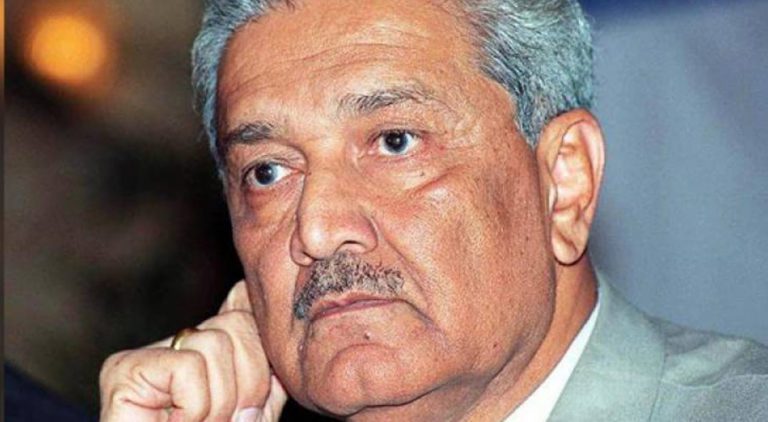
On his death anniversary, Pakistan remembers Dr. Abdul Qadeer Khan, the architect of the country’s nuclear programme and one of the most revered scientists in its history.
Known as the Father of Pakistan’s Nuclear Programme, Dr. Khan’s lifelong efforts transformed the country into the first nuclear-armed state in the Muslim world, reshaping South Asia’s strategic landscape forever.
A Vision Born of Necessity
Following Pakistan’s dismemberment in 1971 and India’s first nuclear test in 1974, the country’s leadership under Prime Minister Zulfikar Ali Bhutto realised the urgent need for a credible nuclear deterrent. Bhutto famously declared that Pakistanis would “eat grass” if necessary, but would develop the bomb.
Around the same time, Dr. Abdul Qadeer Khan, a metallurgist working in the Netherlands at URENCO — a firm involved in uranium enrichment — volunteered his expertise to Pakistan.
His letter to Bhutto proved pivotal, marking the beginning of the nation’s nuclear journey.
Building Kahuta and the Nuclear Programme
Dr. Khan returned to Pakistan in 1976 and established the Engineering Research Laboratories (ERL) in Kahuta, later renamed Kahuta Research Laboratories (KRL) in his honour.
Under his leadership, Pakistani scientists and engineers built uranium enrichment facilities from the ground up — a task few believed possible given the limited resources and global restrictions on nuclear technology.
Despite international sanctions and immense external pressure, Dr. Khan’s team continued their work with remarkable secrecy and commitment. By the late 1980s, Pakistan had achieved the technical capability to develop nuclear weapons.
May 1998: The Moment of Triumph
On May 28, 1998, Pakistan conducted its first nuclear tests in Chagai, Balochistan — a direct response to India’s nuclear explosions earlier that month.
The world watched as the mountains of Chagai turned white from the blasts, marking Pakistan’s entry into the elite group of nuclear powers.
The tests were not just a show of scientific prowess but also a declaration of national sovereignty and strength. Dr. Khan, who oversaw key aspects of the enrichment process, became a national hero overnight, celebrated for giving Pakistan a powerful deterrent in a volatile region.
A Legacy of Strength and Self-Reliance
Dr. Abdul Qadeer Khan passed away on October 10, 2021, at the age of 85. His funeral, held at Islamabad’s Faisal Mosque, drew thousands — from dignitaries to ordinary citizens — all united in respect for the man who gave Pakistan its ultimate defence capability.
Today, his legacy lives on not only through Pakistan’s robust nuclear program but also through his emphasis on scientific research, self-reliance, and national dignity.
As Pakistan commemorates him, Dr. Khan’s life serves as a reminder of what vision, determination, and patriotism can achieve — even against the toughest odds.
“We achieved the impossible because we believed in Pakistan,” he once said.
And Pakistan, indeed, will forever remember him as the man who turned that belief into reality.