











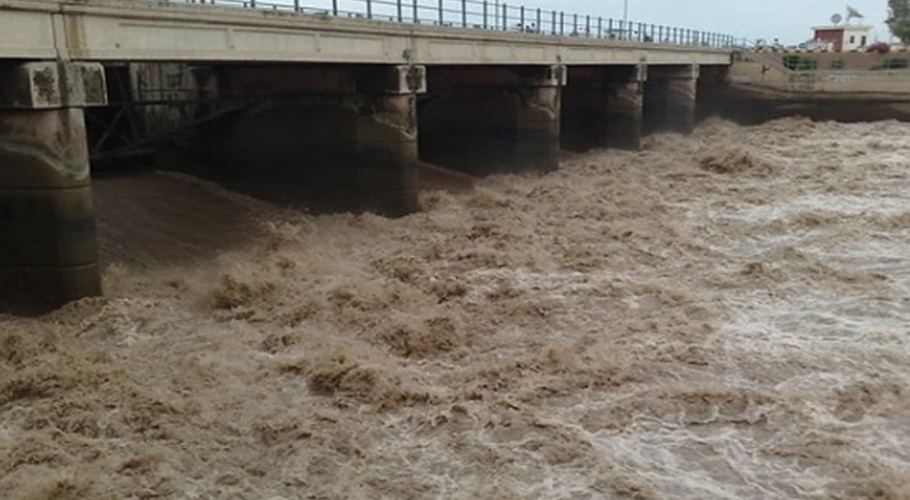
Severe flooding has brought devastation to Punjab as major rivers—including the Ravi, Chenab, and Sutlej—have overflowed due to continuous monsoon rains and water discharges from India. Dozens of villages are submerged, crops over thousands of acres lie underwater, infrastructure has collapsed, and at least seven lives have been lost as authorities scramble to prevent further disaster.
The situation at Head Qadirabad on the Chenab River has become critically dangerous, with the water flow reaching 996,000 cusecs—nearly 200,000 cusecs above its designed capacity. According to Irfan Ali Kathia, Director General of Punjab’s Provincial Disaster Management Authority (PDMA), the rising pressure especially on the left embankment may lead to a catastrophic breach. Immediate evacuation orders have been issued for vulnerable areas including Hafizabad and Chiniot, and rescue agencies, irrigation departments, and district administrations are working urgently to reinforce the embankments using all available resources.
Across Punjab, the flood situation has worsened significantly in the wake of continued heavy rainfall. India’s release of excess water into downstream rivers has caused water levels in the Ravi, Chenab, and Sutlej to rise to dangerous levels. In Gujranwala division alone, seven people have died and three others are missing due to flood-related incidents. Fatalities were reported from Gujrat, Sialkot, Narowal, and Gujranwala. In Sialkot’s Sambarial area, three people were swept away in floodwaters and remain unaccounted for.
The situation is equally alarming at Shahdara where a major flood wave is passing through the Ravi River. Water flow has already crossed 125,000 cusecs, with officials anticipating up to 160,000 cusecs by morning. While the river’s total capacity stands at 250,000 cusecs, authorities are on high alert and continue evacuating residents from the riverbed and surrounding low-lying neighborhoods.
Narowal is among the worst-hit areas, with villages submerged, roads like the Shakargarh-Narowal highway underwater, and a railway track at Qila Ahmadabad washed out—forcing train services to be suspended. In Kot Nainan, a point along the Ravi, the flood is categorized as “very high,” leading to the collapse of multiple bridges and roads, and cutting off access to numerous communities.
Wazirabad is also under severe strain as the Palkhu Nala, overwhelmed by inflow from the Chenab, has overflowed and inundated the city and nearby settlements. Agricultural land has suffered immense losses—five acres submerged in Gujranwala alone—while in villages like Sajjadah in Hafizabad, bridges have collapsed. Further south, areas in Muzaffargarh have flooded, with a larger flood wave expected in the coming days.
The Sutlej River has seen one of its worst flood episodes in recent years. At Ganda Singh Wala near Kasur, the flood is classified as “extremely high.” Entire villages have been encircled by water. Despite continuous warnings and loudspeaker announcements, many residents are refusing to abandon their homes and livestock. In Bahawalnagar and Vehari, damage to cotton and paddy crops is widespread. In Mailsi, a breach in a protective embankment has flooded farmlands and homes. Multan’s Jalaipur Pirwala area has also been hit hard, with floodwaters entering residential zones and rescue operations ongoing.
Amid this growing crisis, the Meteorological Department has forecast even more intense rainfall from August 29 to September 2. Moist winds from the Arabian Sea and the Bay of Bengal are expected to enter Pakistan on August 29, followed by a westerly weather system on August 30. Upper and central parts of the country are expected to receive further heavy downpours. The new rains could aggravate flooding in rivers and nullahs in Kashmir, Murree, Islamabad, and Rawalpindi, with flash flood threats extending to Chitral, Dir, Swat, Shangla, Buner, Swabi, and Mardan. Low-lying urban areas in Lahore, Gujranwala, Sialkot, Faisalabad, Peshawar, and Mardan also face risks of waterlogging.
Authorities have also warned of possible landslides in hilly areas of Khyber Pakhtunkhwa, Gilgit-Baltistan, Murree, and Kashmir. Strong winds and intense rainfall are expected to further damage weak infrastructure including electric poles and billboards, potentially disrupting power and transport services in affected areas.
As the flood emergency deepens, the country braces for continued weather instability, while provincial administrations, disaster management authorities, and military units remain on high alert to manage the unfolding humanitarian crisis.