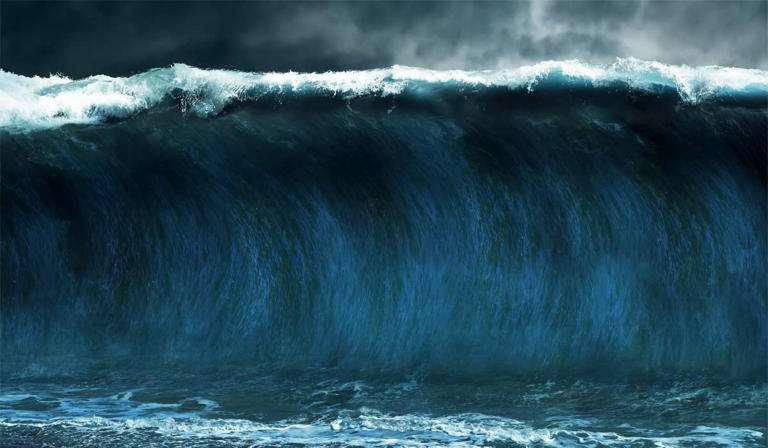
Scientists have issued a grave warning about the possibility of a destructive mega-tsunami striking parts of the U.S. Pacific Coast, triggered by a major earthquake along the Cascadia Subduction Zone (CSZ).
The fault line, stretching from Northern California to Vancouver Island, has been accumulating massive tectonic stress as the Juan de Fuca Plate continues to slide beneath the North American Plate.
A new study by researchers at Virginia Tech identifies the Cascadia Subduction Zone as one of North America’s most hazardous seismic regions. Over centuries, stress builds silently until it is released in the form of a powerful earthquake.
Such an event could cause sudden land subsidence, drastically expanding floodplain areas and reshaping coastlines. The last great earthquake along this fault occurred in 1700, generating a tsunami so powerful that it was recorded as far away as Japan.
The Virginia Tech research team, led by geoscientist Tina Dura, has highlighted the significant risks if a similar event were to occur today. With dense populations, urban infrastructure, and critical transportation networks concentrated along the West Coast, the impact would be catastrophic.
Their findings, published in the Proceedings of the National Academy of Sciences, estimate a 15 percent chance of a magnitude 8.0 or greater earthquake along the CSZ within the next 50 years.
According to the study, such an earthquake could abruptly sink coastal land by as much as 6.5 feet, creating conditions for a mega-tsunami with waves hundreds of feet high.
Southern Washington, northern Oregon, and northern California are identified as the regions most vulnerable to widespread flooding and inundation.
Alaska and Hawaii, while also at risk from seismic and tsunami activity due to their own fault lines, are considered geographically less exposed to immediate danger from a CSZ rupture.
Compounding the threat, researchers warn that low-lying areas along the Pacific coast could face permanent inundation, especially when combined with projected sea-level rise caused by climate change by the end of the century.
“This is not just a geological scenario—it’s a direct challenge to coastal resilience and preparedness,” the Virginia Tech team stressed, urging authorities to strengthen disaster readiness and infrastructure planning before the inevitable occurs.