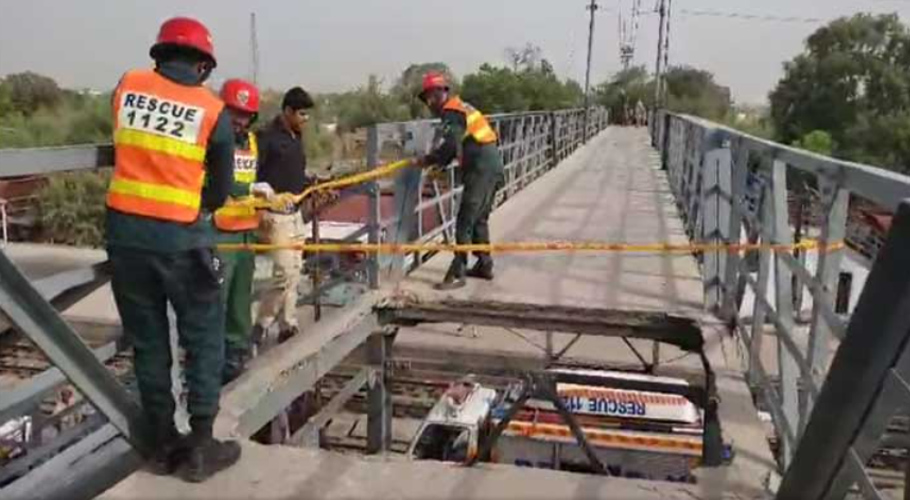
A pedestrian bridge at Khanewal Railway Station collapsed, resulting in the death of a railway official. Some reports claim that the bridge was built before the creation of Pakistan.
According to rescue officials, the collapse of the bridge near the railway station caused the railway ST to be buried under the debris and die, while a woman was seriously injured in the incident. She has been shifted to the hospital.
In one report, citing railway sources, it was mentioned that the collapsed bridge at Khanewal Railway Station was constructed before the creation of Pakistan.
The infrastructure built before the creation of Pakistan (1947) included many roads, railway bridges, canal systems, buildings, and other civil engineering projects. These constructions were mostly carried out during British rule, and their main feature was that they were built to be strong and durable. However, such constructions have now exceeded their lifespan.
As 78 years are about to be completed since the creation of Pakistan (1947), and due to the lack of regular maintenance or monitoring for several decades, such constructions have become weak. Over time, climate change, fluctuations in water levels, earthquakes, rain, and increased loads have affected them.
Bridges and roads that were once built for limited traffic now experience traffic many times greater.
Especially in Punjab and Sindh, bridges built in the late 19th and early 20th centuries—such as the Chenab Bridge, Jhelum Bridge, and the bridge near Sukkur Barrage—are still often in use. Many DC offices, courthouses, railway stations, schools, and hospitals are also in a dilapidated condition.