










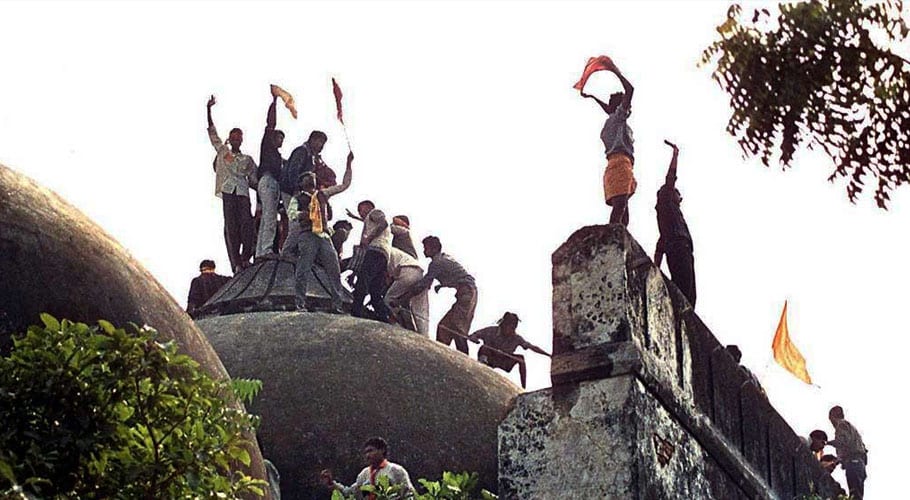
NEW DELHI: An Indian special court delivered his verdict in the Babri mosque demolition case on Wednesday, nearly three decades after the 16th-century structure was razed by a Hindu mob in Ayodhya.
India’s Central Bureau of Investigation (CBI) judge Surendra Kumar Yadav delivered his verdict in the Babri Masjid demolition case acquitting all 32 suspects citing lack of evidence.
The key accused include former deputy prime minister LK Advani, former union ministers MM Joshi and Uma Bharti and former Uttar Pradesh chief minister Kalyan Singh. Most of the senior leaders among the 32 accused were not present in the Lucknow court.
The 32 suspect face charges under several sections of the Indian Penal Code (IPC) including criminal conspiracy, rioting, promoting enmity between different groups and unlawful assembly.
During the trial, the CBI produced 351 witnesses and 600 documents as evidence before the CBI court. The court had initially framed charges against 49 accused while 17 accused have died.
The accused were also facing charges of having made assertions “prejudicial to national integration and injuring or defiling a place of worship”.
Advani, aged 92, and MM Joshi, aged 82, the two former presidents of the Bharatiya Janata Party, were accused with a host of rightwing Hindu activists of criminal conspiracy to raze the mosque in Ayodhya on 6th December 1992.
They are also accused of fomenting enmity between communities. Other BJP leaders accused in the trial are senior party leaders Uma Bharti and Kalyan Singh.
The Indian Supreme Court has recently awarded the land on which the mosque was located to a Hindu trust to build a temple there. The CBI first filed conspiracy charges against the top BJP leaders and then dropped it. In 2017, the Indian Supreme Court asked to conduct day-to-day hearings but the verdict was delayed.
ADVERTISEMENT