







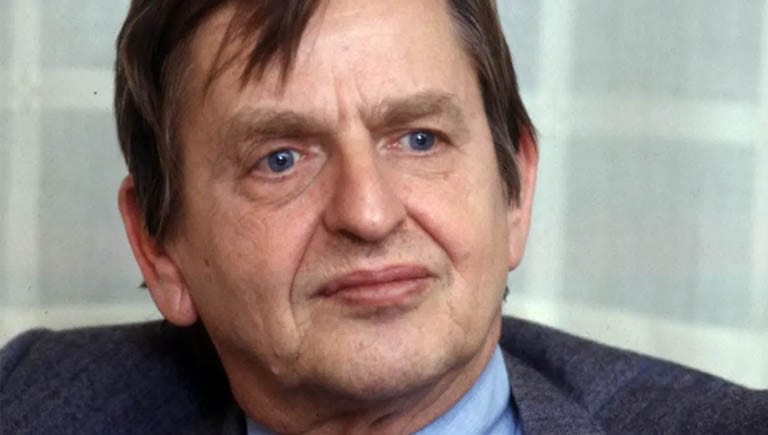
STOCKHOLM: Swedish prosecutors have named their main suspect in the 1986 killing of prime minister Olof Palme and closing the murder case that has gripped the country for more than three decades.
The suspect was named as Stig Engstrom, a former advertising consultant known for his staunch opposition to Palme’s leftwing policies and who is now dead.
Palme was gunned down on the evening of February 28, 1986, after leaving a Stockholm cinema with his wife, having dismissed his bodyguards for the evening.
He was shot in the back by his assailant, who fled the scene and left him to die on the sidewalk. The gruesome murder shocked Swedes and had remained unresolved since then.
More than 10,000 people have been questioned over the years, and 134 people have confessed to the crime though none has been credibly tied to it.
Chief prosecutor Krister Petersson said they had zeroed in on Engstrom as the main suspect. “Because he is dead, I can’t press charges against him, and have therefore decided to close the investigation,” he said.
He acknowledged that while only a court can determine guilt but he is convinced there is evidence of reasonable suspicion.
Engstrom, who was 52 at the time of the murder, was questioned as a witness early on, but police deemed him unreliable after he changed his story several times. The media has suggested over the years that he was trying to cover up his role as the gunman. He died in 2000 aged 66.
Palme’s son Marten said he believed prosecutors made the right call. “I think Engstrom is guilty. Given the current situation, I think it is reasonable to close the investigation,” he said.
Another man was convicted of the crime in July 1989 after Palme’s widow identified him in a line-up. Christer Pettersson, a petty criminal and drug addict, was freed months later by an appeals court which dismissed the widow’s testimony on a technicality. Pettersson died in 2004 while Palme’s widow passed away in 2018.
Swedish Prime Minister Stefan Lofven said it had been “a day full of emotions” and stressed that it was not the government’s place to judge the prosecutor’s conclusions. “For a country’s prime minister to be murdered is a national trauma. It is my hope that this wound can now heal.”
Petersson said investigators believe Engstrom acted alone but did not dismiss the idea that he could have been part of a conspiracy.
He said Engstrom told investigators early on that he had arrived at the scene moments after the shots were fired, and left before police arrived. Engstrom said he had turned Palme on his side but police were never able to confirm that assertion.
Petersson stressed Engstrom’s political views as a possible reason for wanting Palme dead. Palme was a controversial figure who infuriated Washington with his vocal opposition to the US war in Vietnam. He also backed communist governments in Cuba and Nicaragua.
He was at odds with the country’s business leaders and military and spoke out against nuclear power. Engstrom had an adverse opinion of Palme and his politics.
He also noted that Engstrom had access to weapons through acquaintances and had weapons training. The gun used in Palme’s murder has never been recovered.
ADVERTISEMENT