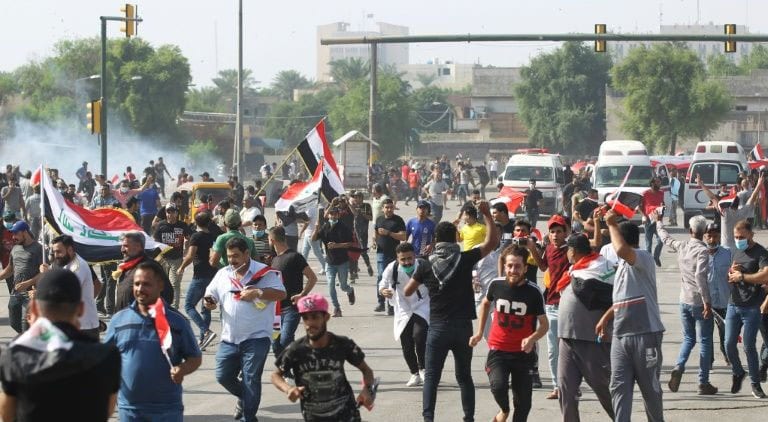
BAGHDAD: More than a dozen demonstrators died in renewed rallies across Iraq’s capital and the south on Friday, with the first reported use of live rounds in this wave of protests.
The demonstrations represent a second phase of a week long movement in early October demanding an end to widespread corruption, unemployment and an overhaul of the political system.
Activists urged Iraqis to return to the streets on Friday, which marks a year since Prime Minister Adel Abdel Mahdi came to power. The rallies began early, with hundreds already gathering in the capital’s iconic Tahrir (Liberation) Square on Thursday evening.
On Friday, many crossed the bridge to mass near Baghdad’s Green Zone, which hosts government offices and foreign embassies, but security forces used a volley of tear gas to push them back.
“Two demonstrators died, with preliminary information indicating they were hit in the head or face by tear gas canisters,” said Ali Bayati, a member of the Iraqi Human Rights Commission. He said nearly 100 more were wounded, but there were no reports of live fire being used to disperse protesters in the capital.
But in the southern city of Amarah, five protesters were shot dead as they tried to storm the headquarters of the powerful Asaib Ahl al-Haq armed faction, medics and security sources said. And in nearby Nasiriyah, another five protesters were shot dead and 18 wounded.
Thousands had gathered there in the afternoon, setting fire to the government’s provincial headquarters. Others across the south set light to more than a dozen political party headquarters and offices of parliamentarians.
Two more protesters died of burns sustained when setting fire to one of the offices, bringing the nationwide toll to 14 dead.
Iraq’s highest Shia authority Grand Ayatollah Ali al-Sistani had set Friday as the deadline for Abdel Mahdi to respond to demonstrators’ demands.
In a much-awaited sermon, Sistani’s representative urged protesters and security forces to show “restraint,” warning of “chaos” if violence broke out again.
His sermon appeared to echo the package of reforms put forward by Abdel Mahdi, including an anti-corruption campaign, a job creation drive and improved social welfare.
READ MORE: Death toll in Iraq protests rises to 60
But demonstrators did not appear impressed. “Adel Abdel Mahdi is lying to us,” protesters shouted in Baghdad, just hours after the premier’s televised appearance in which he defended his reform agenda.
“They are all liars — they lie when they promise us jobs and when we protest, they fire tear gas at us!” shouted another.
The real test was to be later in the afternoon, when many were expecting supporters of Moqtada al-Sadr — an influential cleric who controls the largest parliamentary bloc — to hit the streets.
His supporters have breached the Green Zone in previous years. This week, he called on them to protest and even instructed members of his own paramilitary force to be on “high alert”.
They could be seen in parts of Baghdad on Friday in a clear show of force. The movement is unprecedented in recent Iraqi history both because of its spontaneity and independence, and because of the brutal violence with which a torrent of protests on October 1-6 was met.
At least 157 people were killed in early October, according to a government probe published on Tuesday, which acknowledged that “excessive force” was used.
A vast majority of them were protesters in Baghdad, with 70 percent shot in the head or chest. Some have backed the government, including the powerful Hashed al-Shaabi paramilitary force whose political branch is the second-largest parliamentary bloc.
Restrictions had even softened around the Green Zone but were reinstated as the October demonstrations picked up in Tahrir Square, which lies just across the Tigris River.
Authorities also imposed an internet blackout, which has been mostly lifted although social media remains blocked.
ADVERTISEMENT