










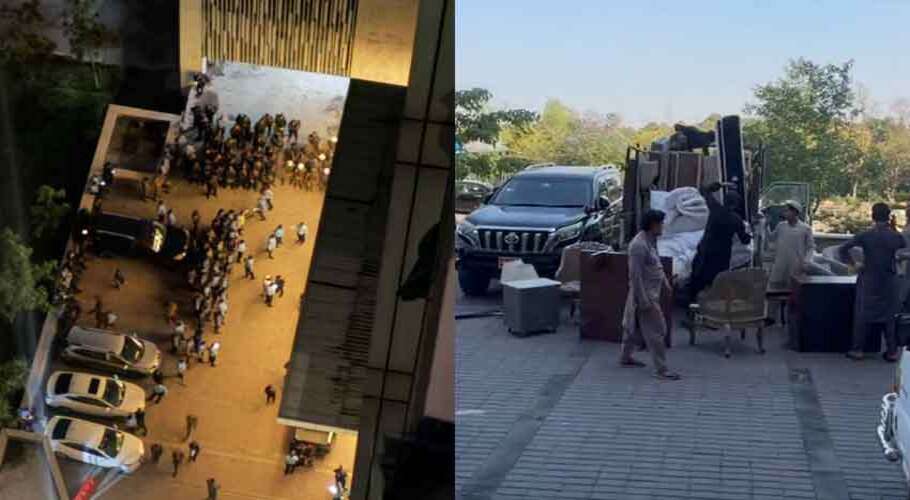
ISLAMABAD: Residents of One Constitution Avenue were jolted from their homes in the middle of the night last week as authorities, backed by an Islamabad High Court (IHC) verdict, began evicting families from the high‑rise residential complex in the capital’s Red Zone. The operation, carried out with heavy police presence and little notice, has shifted the spotlight from the legality of the lease cancellation to a more uncomfortable question: Who is really responsible for putting ordinary buyers and tenants in this position after two decades of missed payments and legal twists?
I rent at One Constitution Avenue. At 1 AM last night, I was jolted awake by heavy banging on the door. My first panicked thought: thieves. Instead, I was greeted by 50 heavily armored police officers — rude, aggressive, and clearly ready to beat us into submission if we…
— Nadeem Haque (@nadeemhaque) May 1, 2026
A deeper research by MM News shows the 13.5‑acre plot at One Constitution Avenue was originally allotted to BNP Pvt Ltd by the Capital Development Authority (CDA) in 2005 under a lease meant for a hotel project, after the company qualified through an auction. Over time, the project morphed into luxury apartments, with allegations that the conversion occurred without complete approvals and in violation of lease conditions.
CDA records show that BNP failed to meet multi‑billion‑rupee payment obligations stretching over almost 20 years. In 2016, the CDA cancelled the lease citing violations and non‑payment; that cancellation was later upheld by the Islamabad High Court.
سب سے پہلے سی ڈی اے کے ان افسران کو لٹکانا چاہیے جنہوں نے ہوٹل کو رہائش گاہوں میں بدلتے دیکھا اور اس وقت ایکشن نہیں لیا ۔یہ وزارت داخلہ اور سی ڈی اے کے لیے ایک ٹیسٹ کیس ہے ایک جانب کچی آبادیاں مسمار کی گئیں اور دوسری جانب لگژری فلیٹس پر کمیٹی قائم کی گئی ۔دیکھتے ہیں کہ کیا ہوتا https://t.co/Kq9UFItjrf
— ijaz muhammad (@ijazbannu) May 2, 2026
In January 2019, a three‑member Supreme Court bench led by then‑Chief Justice Mian Saqib Nisar overturned the IHC’s decision and restored the lease to BNP Pvt Ltd, but on strict terms. The Court directed the company to pay Rs17.5 billion to the CDA in eight equal annual instalments, with the explicit condition that any default would empower the CDA to terminate the lease.
This order allowed the project to continue and encouraged further sales and occupancy. However, reports indicate BNP paid only the first instalment—around Rs1.7–2.9 billion—before defaulting on the remaining payments, leaving the bulk of the dues unpaid.
By 2023, after BNP’s continued failure to meet the Supreme Court’s payment schedule, the Court itself noted that the 2019 judgment had been “overtaken by events” and dismissed the company’s review petition, effectively allowing the lease cancellation to stand. The CDA then moved to formally reclaim possession of the plot.
On April 30, 2026, the Islamabad High Court upheld that cancellation, rejecting petitions filed by BNP Pvt Ltd and by some apartment owners. The ruling reinforced the CDA’s position that the lease was lawfully terminated due to the developer’s long‑running default, providing the legal basis for the subsequent eviction drive.
From Court Order to Midnight Raids
The enforcement phase, however, quickly became explosive. Authorities, supported by police, reportedly went door‑to‑door in late April and into early May, instructing residents to vacate by midnight, often giving them only 24 hours to leave. Social‑media posts and on‑the‑ground accounts describe shock, confusion, and distress as families were asked to dismantle their lives overnight.
Civil‑society groups and some legal commentators have criticised the operation as disproportionate in tone and timing, even if technically grounded in the court order. The midnight raids generated domestic and international backlash, with critics arguing that the optics of state force—coming down on residents after decades of institutional failures—undermine efforts to project a rule‑of‑law‑based administration.
Prime Minister Shehbaz Sharif has since formed a high‑level committee to review the One Constitution Avenue file, directing authorities to examine the project’s approvals, financial flows, and the impact on third‑party buyers and tenants in a transparent manner.
Multiple Layers of Responsibility
The case exposes a chain of culpability rather than a single villain.
– BNP Pvt Ltd and its principals: On the contractual side, the developer is widely seen as the primary actor that turned a hotel‑zone lease into residential apartments without full compliance and then defaulted on dues amounting to billions of rupees over two decades. Any attempt to shield it from consequences would reward protracted violations of public‑land leases.
– CDA and past administrations: How a hotel lease in the capital’s most sensitive area was allowed, or overlooked, to morph into a luxury residential tower for so long has long been questioned. Successive governments, regulatory bodies, and CDA boards have been accused of enabling or ignoring violations, deepening concerns about regulatory capture and political patronage dating back at least to the Musharraf era.
– Judiciary (Nisar‑era Supreme Court): The 2019 order, while framed as a conditional lifeline, has drawn sharp criticism. Critics argue that the Court—by restoring the lease despite prior CDA cancellation and litigation—effectively regularised what many regarded as an illegal conversion. That decision allowed years of further investment by third‑party buyers, only for the developer’s later payment failures to become the very justification for the lease’s final cancellation.
– Buyers, investors, and tenants: Not all are equally culpable. Some elite or well‑connected buyers may have known or should have known about the litigation and risks. Yet many third‑party purchasers and tenants bought or rented in good faith, relying on marketing and the apparent stability of the project after the 2019 Supreme Court order. Blanket moral condemnation of them ignores the information asymmetry between large developers and ordinary investors.
Why “Letting It Go” Is Not Neutral
Allowing the matter to simply fade away would send several powerful signals:
– It would reward long‑standing violations of public‑land leases and payment defaults, reinforcing a pattern where delays, influence, and litigation are used to override contractual obligations.
– It would further erode trust in institutions, feeding the perception that rule‑of‑law enforcement is selective and that well‑connected actors can bend, but ultimately not break, the system.
– It would leave genuine investors and tenants in permanent uncertainty, unable to plan their lives or investments in a stable regulatory environment.
By contrast, treating the lease cancellation as a legal consequence of the developer’s default, rather than a political vendetta, aligns with a stricter contractual reading of public‑land use. If the lease is lawfully cancelled, the logical next steps include recovering outstanding dues through transparent mechanisms, re‑auctioning or re‑developing the plot under clear rules, and introducing systemic reforms to prevent similar conversions and payment defaults in future projects.
Protecting Ordinary Stakeholders While Enforcing Law
The immediate challenge is to reconcile two imperatives: upholding the legal validity of the lease cancellation on one hand, and minimising the harm to bona fide buyers and tenants on the other.
Policy and legal experts have suggested that the main burden should fall on the developer and its principals, not on ordinary residents. Proposed measures include compensation or alternative arrangements for those who entered the project in good faith, and phased transition plans that avoid abrupt midnight evacuations and allow families time to relocate or negotiate settlements.
Critics of the midnight‑raid‑style operation argue that even if the IHC order is legally sound, the manner of execution reflects poor administrative judgment and risks exporting images of heavy‑handed state action that undercut confidence in institutions.
A Systemic Problem, Not Just a Single Case
At its core, the One Constitution Avenue saga is less about one court order or one administration than about an incentive system that has repeatedly rewarded developers and powerful actors who stretch rules, delay payments, and exploit political and judicial channels. When the legal scaffolding finally collapses decades later, it is often ordinary investors and tenants who bear the brunt.
How Pakistan handles this case—ensuring accountability for specific actors without scapegoating residents, enforcing contracts without panic, and tightening oversight of high‑value public land—will set a precedent for how similar “toxic” projects are treated in the future.
For now, as families pack their belongings under the glare of midnight notices and court‑enforced orders, the central question lingering over Islamabad is not just who is being evicted, but who allowed such a situation to persist for 20 years in the first place.