











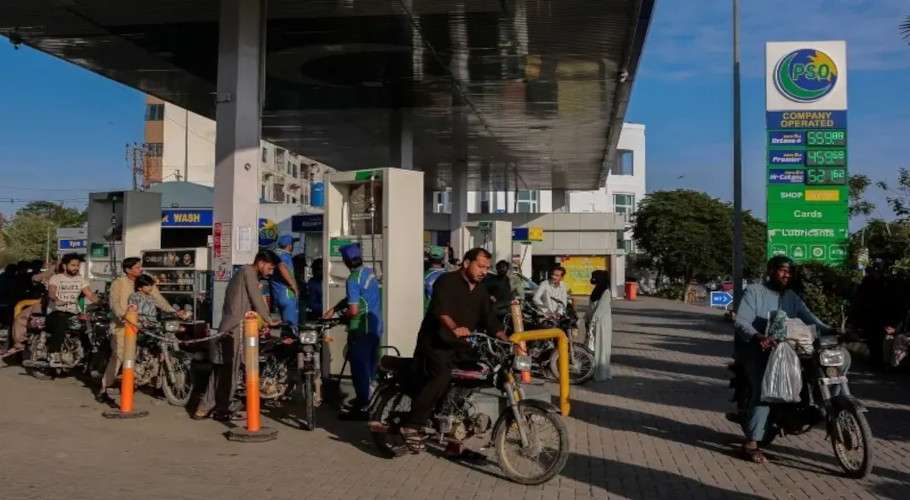
Announcing the hike in prices of petroleum products Friday night, Petroleum Minister Ali Pervez Malik issued statement saying:
– Oil prices are increasing once again in the global market due to regional tensions
– Due to the pressure of rising oil prices and agreements with global partners, the government is having to take steps to shift the burden of oil price hike
– In view of these circumstances, the price of diesel is being increased by Rs 26.77 and the price of petrol by Rs 26.77 for the next week
– As far as possible, the government tolerated the increase in the prices of petroleum products at the global level
– All provincial governments, including the federal government, gave a historic relief package to the people
– I pray that progress is made soon in achieving regional peace and relief can be provided to the people in the prices of petroleum products
In the theater of modern geopolitics, the role of a Petroleum Minister is often less about leadership and more about crisis management within a vacuum. Minister Ali Pervaiz Malik’s recent justification for fuel price hikes serves as a masterclass in the rhetoric of “The Sovereign Straitjacket”—a state where domestic policy is no longer authored by the state itself, but co-authored by international creditors and global market volatilities.
Traditionally, a government acts as a shock absorber, a mediator standing between the brutal fluctuations of the global commodity market and the socio-economic stability of its citizenry. However, when a nation is bound by structural adjustment programs—the “agreements with global partners”—the government’s role shifts fundamentally.
The mediator becomes a conduit. Instead of absorbing the pressure, the state is forced to “shift the burden.” This is the point where economic necessity collides with political survival.
The “constraints” mentioned in the Minister’s statement are not merely suggestions; they are the ironclad conditions of fiscal solvency.
– The IMF Factor: For a developing economy, “global partners” often translates to a singular mandate: Fiscal Discipline over Social Subsidy. The agreement dictates that the state cannot intervene to lower prices if it means increasing the budget deficit.
– The Debt-Dependency Loop: When a government admits it is “having to take steps” to pass on costs, it is acknowledging that the cost of disobeying- the global partner (default, isolation, or currency collapse) is viewed as more catastrophic than the domestic inflation caused by the hike.
– Externalized Accountability: By citing these agreements, the state effectively “blames” the global system. It frames the price hike not as a policy choice, but as an extrinsic requirement.
There is a profound irony in a sovereign state declaring itself powerless. When the burden is shifted to the public, it isn’t just a financial transaction; it is a transfer of risk. The state secures its macroeconomic standing with the IMF, but the microeconomic reality for the citizen—transportation costs, food inflation, and reduced purchasing power—becomes the new “collateral” for national stability.
The Minister’s statement is a candid admission of limited agency. It highlights a world where the “sole mediator” is increasingly a spectator to its own economic fate. In the tug-of-war between global creditors and local voters, the rope is the national economy—and as global tensions rise, the tension on that rope only tightens.
For Pakistan, and many nations in similar positions, the “agreements” are both a lifeline and a leash. The challenge for the future is not just managing the next price hike, but renegotiating a position where the state can once again act as a shield for its people, rather than a bridge for their burdens.
https://archive.mmnews.tv/fuel-volatility-exposes-limits-of-pakistans-peace-mediator-ambitions/