










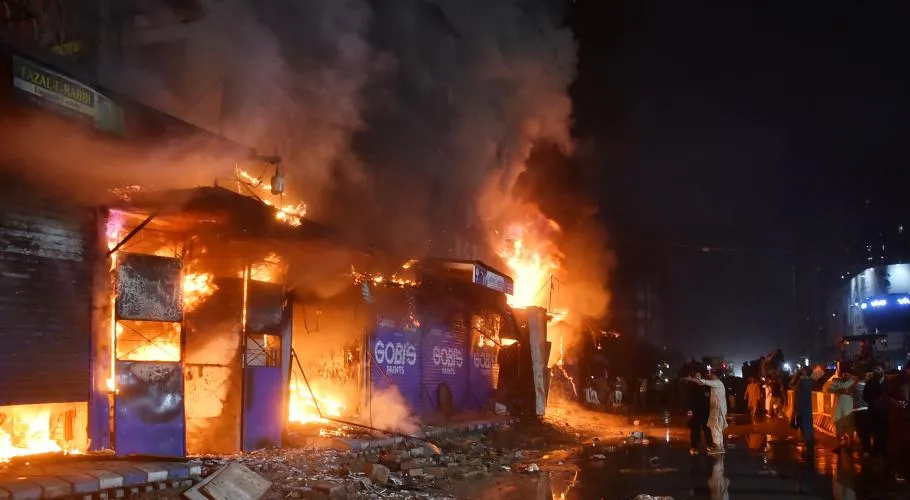
Scientists who conducted DNA identification of Gul Plaza fire victims have disclosed that the inferno burned at temperatures between 800 and 1,200 degrees Celsius, so intense that in several cases, nothing remained of human bodies but bone fragments, and in some instances, powder and ash.
The revelations came in an exclusive report of The Express Tribune by Prof. Dr. Raza Shah, Director of the International Centre for Chemical and Biological Sciences at the University of Karachi, and Prof. Dr. Ishtiaq Ahmed, who heads the Sindh Forensic and Serology Laboratory.
Prof. Ahmed, who led the DNA identification process, said the forensic laboratory received 48 post-mortem samples for analysis. Of those, 24 victims were fully identified and eight were partially identified, with 56 reference samples collected from relatives for matching.
In the most severe cases, he said, the condition of remains made DNA extraction nearly impossible. “Due to the very high burning level, DNA analysis of certain samples was not possible,” he confirmed.
Prof. Shah, who has researched fire dynamics extensively and authored a book on the subject, said examination of bone structures pointed directly to the extreme temperatures involved. In some samples, he noted, even the calcium content within bones had been depleted, a marker of exceptionally sustained and intense heat.
He explained that Gul Plaza functioned as what many called a “mini Karachi,” stocking an enormous variety of goods that drew customers from across the city. A significant proportion of items stored there were made from plastics and chemically treated materials. When such substances ignite, they either revert to chemical compounds or transform into oil-like substances that dramatically intensify and prolong a blaze.
Critically, Prof. Shah pointed out that water, the primary tool used by firefighters at the scene, is largely ineffective against chemical-based fires and can in some cases make the situation worse.
Foam-based suppressants, he said, would have been the appropriate response. Had foam been deployed earlier, he suggested, the fire may have been brought under control sooner and the scale of human loss potentially reduced.
Both scientists announced that the ICCBS intends to treat the Gul Plaza disaster as a formal case study, with plans to hold a research workshop and symposium examining the scientific, forensic, and fire safety dimensions of the tragedy in the hope that lessons learned may prevent a similar catastrophe in the future.