










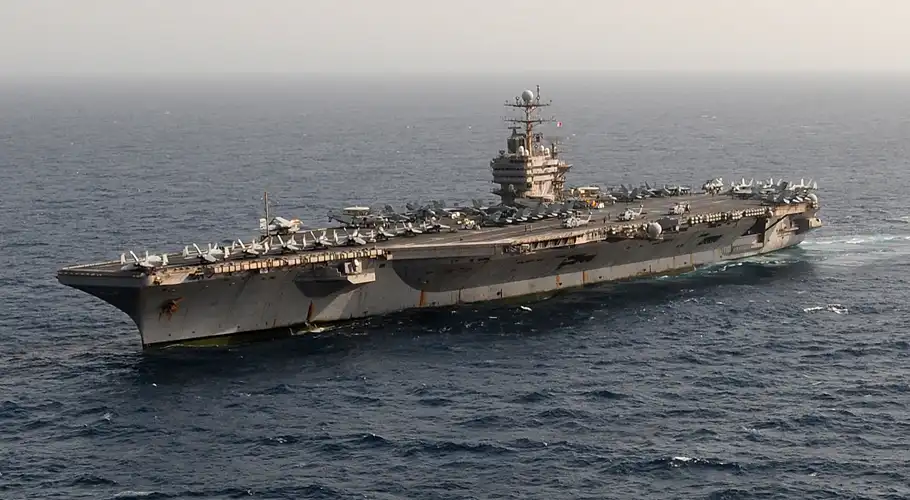
As the USS Abraham Lincoln Carrier Strike Group enters the Arabian Sea, the deployment of this nuclear-powered “floating airbase” signals a major escalation in U.S. regional deterrence.

USS Abraham Lincoln’s
The USS Abraham Lincoln, a nuclear-powered aircraft carrier, has arrived in the Arabian Sea. Its presence strengthens US Central Command, which is headquartered nearby at Qatar’s Al Udeid Airbase.
The carrier is supported by a Strike Group consisting of three Arleigh Burke-class guided-missile destroyers: the USS Spruance, USS Michael Murphy, and USS Frank E. Petersen Jr.
Key Technical Specifications
- Dimensions: It measures 333 meters (1,092 ft) in length.
- Capacity: It carries 90 aircraft and a crew of 5,680 personnel.
- Speed: It maintains a speed of 56 km/h (35 mph).
- The carrier hosts F-35C Lightning II stealth fighters, F/A-18E/F Super Hornets, EA-18G Growler electronic warfare jets, E-2D Hawkeye early warning planes, and MH-60R/S Seahawk helicopters.
Importance of a “Floating Airbase”
A “floating airbase” allows a military to project power without needing permission from foreign governments to use their land.
Mobile Diplomacy
It can be moved to any international waters to show support for allies or deter enemies.
Rapid Response
Because it carries 90 diverse aircraft, it can launch strikes, conduct rescues, or perform surveillance immediately upon arrival in a region.
Versatility
It serves as a command center, a hospital, and a runway all in one, making it the ultimate tool for maritime control.
Importance of Nuclear Power
Nuclear-powered craft like the USS Abraham Lincoln offer unique advantages over traditional fuel-powered ships
Nuclear reactors allow the ship to operate for over 20 years without refueling, meaning it can stay on station for as long as the crew has food.
Since the ship doesn’t need massive tanks for ship fuel, that space is used to carry more aviation fuel and ammunition for the aircraft.
Nuclear power provides the massive energy needed to launch heavy aircraft via catapults while simultaneously moving the 333-meter vessel at high speeds.